The Hangar
14 curated craft archetypes across the sighting literature — the Bestiary's sibling collection. Reported flight behavior and the skeptical reading, side by side.
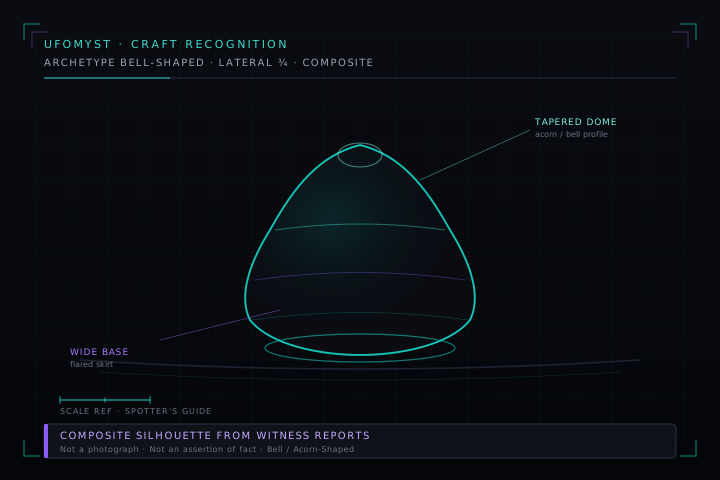
Bell / Acorn-Shaped
A tapered, rounded-conical body — wider at the base, narrowing toward a blunt or domed top, roughly the profile of a large bell, acorn, or old-style diving bell. Bell-shaped reports are comparatively rare and are disproportionately tied to fireball and crash-adjacent events rather than routine night-sky sightings: the object is typically first noticed as a brilliant meteor-like streak before witnesses on the ground, closer to the apparent impact point, describe a distinct acorn- or bell-shaped body rather than a formless fireball. This makes the type ufology's clearest overlap category with bolide/meteorite misidentification, and its best-known case remains genuinely unresolved because the object itself was never examined by independent civilian investigators before it left the scene. What sets the bell type apart from a simple meteorite fall is the follow-up: at Kecksburg, witnesses described a rapid, coordinated military response — the woods cordoned off within the hour and a flatbed truck reportedly seen leaving under tarpaulin later that night — a pattern of visible official interest that, true or not, has become as central to the shape's folklore as the object's silhouette itself. The bell/acorn profile rarely if ever recurs with the calm, hovering behavior typical of discs or triangles; every well-known case in this category involves a fast, descending, meteor-adjacent approach rather than a slow overflight, which is part of why investigators treat it as its own distinct craft type rather than folding it into the general disc or egg categories.
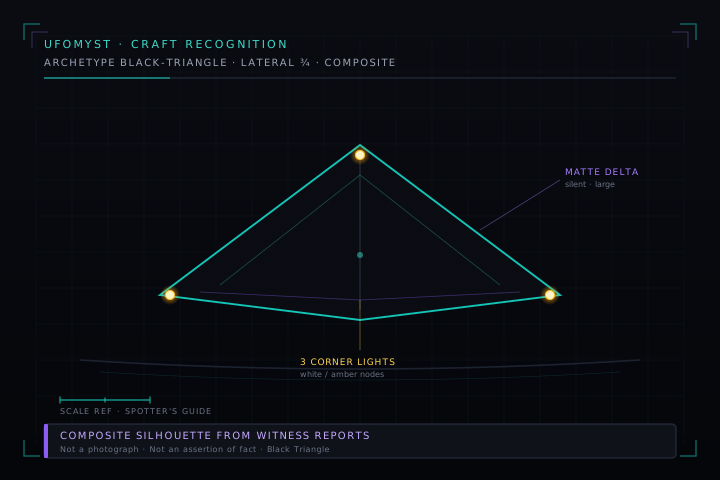
Black Triangle
A large, flat, matte-black or dark-grey triangular or delta-wing craft, typically reported with a bright white or colored light at each corner and sometimes a dim, pulsing central light — moving with total silence at low altitude and low speed, or occasionally hanging motionless for minutes at a time before departing without a sound. Size estimates run enormous: witnesses across the 1989-90 Belgian wave and the earlier Hudson Valley sightings routinely described a triangle the length of a football field or larger, low enough to make its silence itself the most unsettling detail — something that size should not be able to hover, let alone hover quietly. Military and police witnesses feature heavily in the best triangle reports, including Belgian F-16 pilots who locked radar on a triangular target that reportedly dropped altitude by thousands of feet in seconds without measurable acceleration signatures consistent with any known aircraft. A persistent internet and insider-testimony lore holds that some or all black-triangle reports are sightings of a real but secret U.S. antigravity program nicknamed the 'TR-3B' — a claim that remains entirely speculative, sourced to anonymous insiders and a single disputed magazine article rather than any declassified document, and is flagged here as folklore rather than established fact. The shape's silent, slow, low-altitude profile has made it one of the most consistently reported forms since the 1980s, cutting across the U.S., Belgium, and the UK alike.
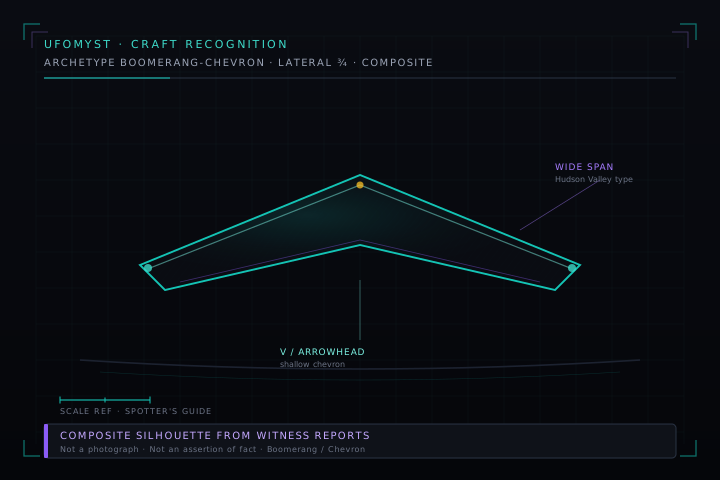
Boomerang / Chevron
A wide, shallow V or arrowhead-shaped craft — flatter and more angular than a triangle, often reported as football-field-sized or larger, with lights or windows spaced evenly along both leading edges. Chevron and boomerang witnesses stress the shape's total silence and its improbable size relative to how low and slow it moves — a profile that, unlike the more agile tic-tac or disc, reads to observers as massive and almost languid, gliding rather than darting. The type anchors two of America's largest mass sightings: the Hudson Valley boomerang flap, which produced roughly 7,000 reports across New York and Connecticut between 1982 and 1995, and the Phoenix Lights, where a mile-wide V of lights crossed Arizona in March 1997 and was watched by thousands including the state's own governor. Both cases share a persistent investigative puzzle: some individual sightings within each flap are well explained by conventional aircraft formations, while a residue of the most detailed reports — describing a single solid structure connecting the lights rather than several separate aircraft — resists that same explanation.
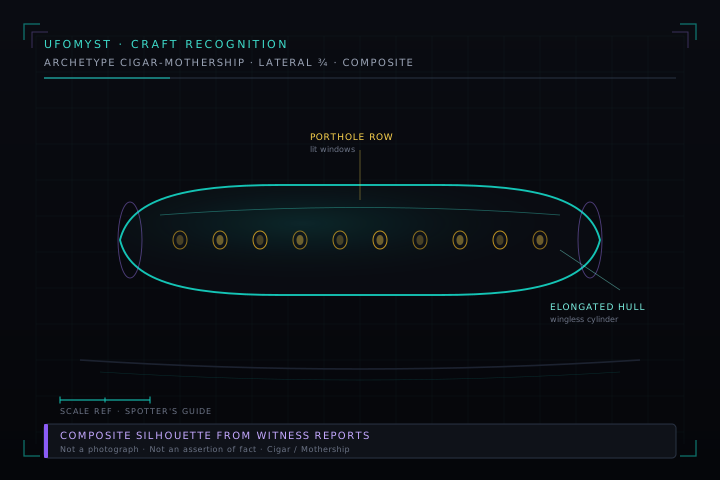
Cigar / Mothership
An elongated, wingless, cylindrical craft — often windowless or lined with rows of small lit portholes — reported at a scale dramatically larger than any other type, sometimes described as 'the size of an aircraft carrier' or larger, sitting motionless in the sky for extended periods before smaller objects are seen departing from or returning to it. The mothership framing treats the cigar shape less as a single vehicle and more as a mobile base: several of the best-documented reports describe secondary discs or lights launching from, orbiting, and re-docking with the main body, a behavior pattern that has no equivalent among conventional aircraft carriers or airships. Unlike the flatter, lens-shaped disc, the cigar is reported as fully three-dimensional and torpedo-like, its great length emphasized far more than its width, and — unlike the black triangle — it is rarely described as flying low or fast; motherships are almost always reported hovering high and nearly still, more like a stationary object being examined from below than a craft in transit.
Cylinder
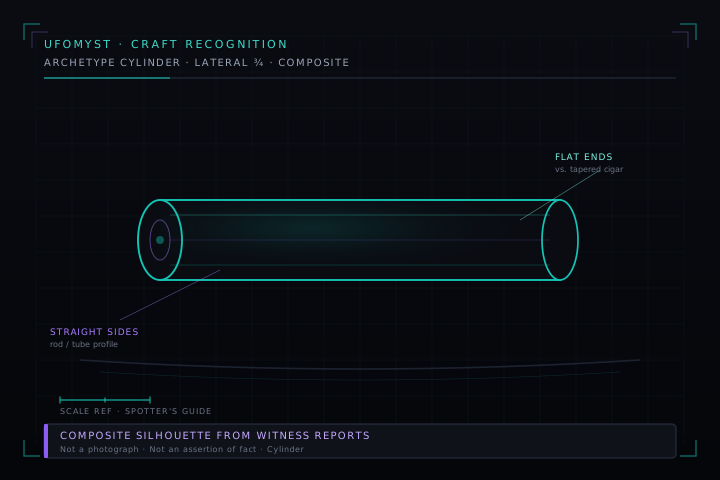
A straight-sided, rod- or tube-shaped object with flat or slightly rounded ends, distinguished from the tapered cigar by its uniform diameter along its full length — closer to a length of pipe than a torpedo. Cylinders are reported across a very wide range of contexts, from brief daylight overflights to extended hovering encounters, and the category's raw NUFORC report count (over 2,100 U.S. sightings) is large despite the type having no single dominant famous case anchoring it the way the disc has Arnold or the egg has Socorro — making it one of the more diffuse, evenly-distributed shapes in the record rather than one built around a handful of landmark encounters. Witnesses describe cylinders in two distinct registers: a fast, purposeful daylight overflight lasting only seconds, often compared afterward to a passing airliner fuselage stripped of wings and tail; and a slower, silent, close-range hover lasting minutes, sometimes with a dull metallic sheen or a row of small lights or windows along one side. Unlike the tapered cigar, which reads to witnesses as a single purposeful vessel, the plain cylinder is more often described in flatly mechanical terms — a pipe, a torpedo, a fuel tank — language that itself hints at how readily this particular silhouette gets compared to ordinary hardware rather than to anything overtly exotic.
Diamond
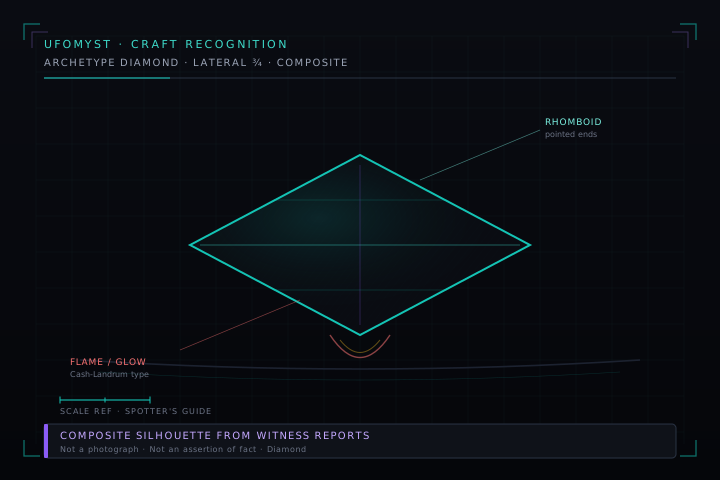
A flattened, four-sided rhomboid — like a disc pulled to a point at each end rather than left round — frequently reported with a fiery or flame-like glow along its edges rather than the cool metallic surface of a classic saucer. The type's two defining American cases are strikingly different in character: the December 1980 Cash-Landrum encounter, where a diamond-shaped object described as 'flaming' hovered low over a rural Texas road escorted by a fleet of military helicopters, leaving three witnesses with radiation-like burns; and the 1990 Calvine photograph, a single, exceptionally crisp image of a massive silent diamond-shaped craft over Scotland that the UK Ministry of Defence reportedly examined and ruled out as fakery internally, yet withheld from public release for thirty-two years. Diamond reports as a class tend to skew toward daylight and close-range sightings rather than distant night lights, which is part of why the shape carries an outsized share of the field's best physical-evidence and photographic cases relative to its overall report frequency.
Egg-Shaped
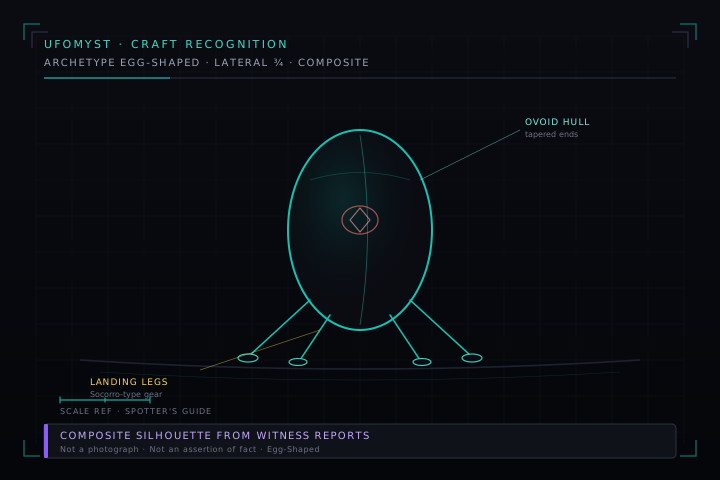
A smooth, symmetrical ovoid — wider than a classic disc but tapered at both ends rather than flat — reported at close range with a matte white or aluminum-colored surface, sometimes bearing a red insignia or marking, and frequently seen landed on tripod-like legs that leave three or four depressions in soil or vegetation. The egg is disproportionately a landing-trace shape: because witnesses tend to encounter it up close and stationary rather than in fast overflight, egg-shaped reports carry an outsized share of ufology's best physical-evidence cases — burn marks, crushed vegetation in a tripod pattern, and localized radiation or magnetic readings at the site afterward. The type's defining case, Socorro 1964, is also one of the rare instances where the shape and its occupants (two small white-suited figures) were reported together by a single trained observer, a police officer, giving investigators an unusually detailed physical description to work from despite the brief encounter.
Flying Disc / Saucer
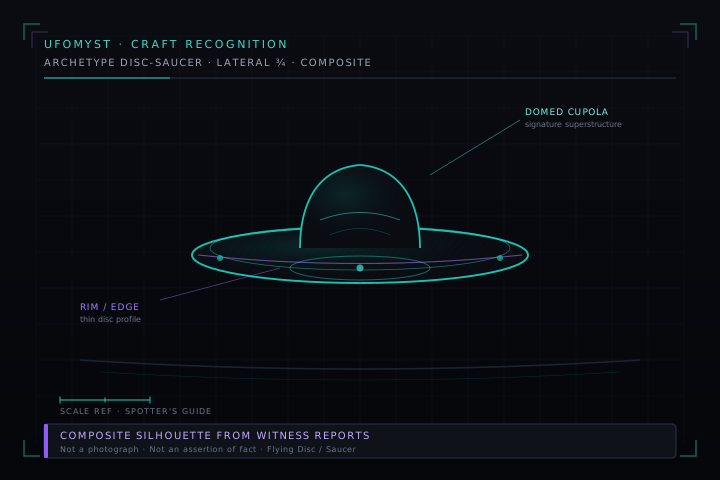
The founding silhouette of the entire phenomenon, even though the man who coined 'flying saucer' was describing something closer to a skipping crescent. A disc or saucer craft is reported as a smooth, symmetrical lens — either a thin plate (the classic 'two plates rim to rim' profile) or a domed variant with a raised cockpit-like bubble on top, sometimes ringed by portholes or a pulsing band of light around its equator. The Adamski-type subvariant, specific to 1950s contactee photographs, adds three ball-shaped landing gear legs beneath a domed saucer and a distinctive scalloped rim — a design later proven to match a hardware-store chicken-feeder incubator lamp with ping-pong balls attached. In flight, witnesses describe silent hovering, sudden vertical ascents, and a wobbling 'falling leaf' descent pattern distinct from any known aircraft. Domed saucers are disproportionately the type reported as landing, sometimes with occupants (usually Suited Dwarfs or Nordics) emerging or visible through the dome. The shape dominates the earliest years of the phenomenon (1947-1965) before daylight discs gradually gave way to the boomerangs, triangles, and unlit orbs of later decades — Hynek's own six-category system still keeps 'Daylight Disc' as one of its three basic sighting classes precisely because of how much of the early record this shape carries. The saucer remains pop culture's default UFO silhouette long after field reports diversified away from it, which is itself a data point about how much the image feeds back into what later witnesses expect to see and describe.
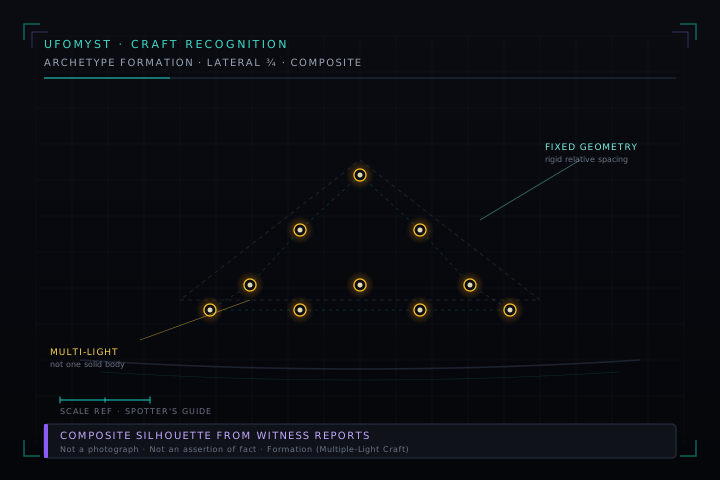
Formation (Multiple-Light Craft)
Not a single solid body but a coordinated cluster of individual lights or objects moving in a fixed geometric relationship to one another — a line, a V, a triangle grid, or an irregular but synchronized pattern — that witnesses frequently perceive and report as one connected structure rather than several separate craft. This is the point where the 'craft vs. shape' distinction matters most directly: a formation sighting can be logged under any single NUFORC shape token depending on what the observer thought they saw, yet as a curated *interpretive* category it covers one of the most persistently recurring perceptual patterns in the whole record, from the eclipse-day discs filmed independently over Mexico City in 1991 to the modern wave of Starlink 'satellite train' reports and 2024's New Jersey drone flap, where genuinely separate objects were widely, if incorrectly, described by the public and some media as a single coordinated craft or 'mothership' event.
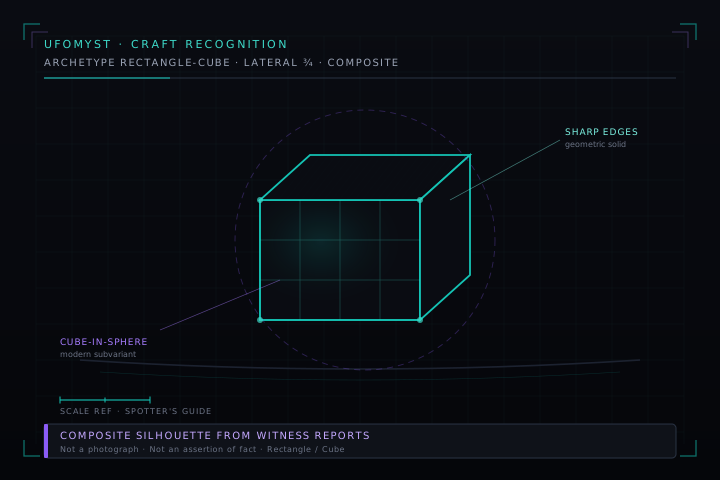
Rectangle / Cube
A sharp-edged, geometric solid — reported either as a flat rectangular panel or, in the type's most striking modern subvariant, as a cube apparently encased inside a transparent or semi-transparent sphere. The cube-in-sphere configuration entered the public record through U.S. Navy pilot reports gathered in the years following the 2004 and 2015 Tic Tac and Gimbal encounters, described as a small, dark, rigid-edged geometric object nested inside a surrounding translucent envelope, observed both visually and on sensor systems by aircrew during routine training flights off the East Coast. Unlike most other craft archetypes here, the cube-in-sphere reports come almost exclusively from a single source stream — military aircrew debriefs later summarized in congressional and Pentagon-adjacent testimony — rather than from a spread of independent civilian witnesses over decades, making it one of the newest and least externally corroborated shapes in this list.
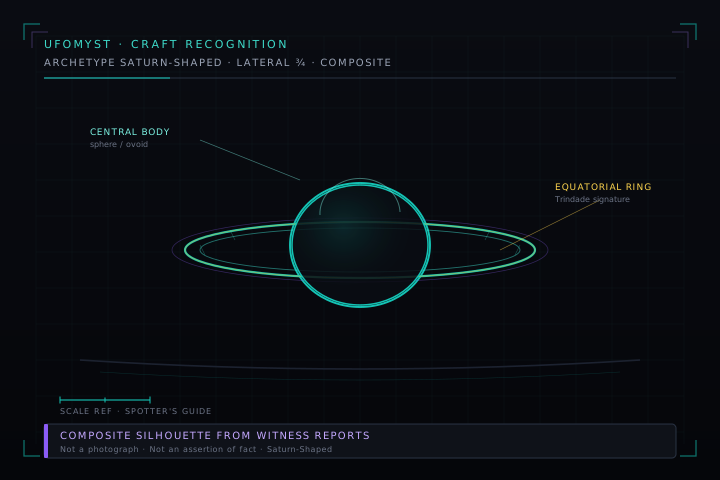
Saturn-Shaped
A spherical or ovoid central body encircled by a distinct flat ring or flange, giving the object a profile that echoes the ringed planet closely enough that witnesses reach for the comparison unprompted. The type is exceptionally rare in the record — far rarer than the disc it superficially resembles — and owes almost its entire evidentiary weight to a single photograph: the January 1958 image taken from the deck of the Brazilian Navy vessel Almirante Saldanha near Trindade Island, showing a dark ringed object against a daylight sky, released to the press with the direct blessing of Brazil's president. Because the case rests on a photograph rather than a landing or occupant report, the entire analytical weight of the case falls on image authenticity — negative chain of custody, film-grain and shadow analysis, and witness corroboration from other sailors on deck — rather than on physical trace evidence. Sailors elsewhere on the Almirante Saldanha's deck reportedly corroborated the sighting independently of the photographer, a detail believers cite as strengthening the case beyond a single potentially motivated source, though no second photograph or instrument reading survives to cross-check the image against. The shape's association with a single Brazilian Navy vessel and a single afternoon — rather than a spread of sightings across witnesses, decades, and countries the way discs or triangles accumulate — is itself part of what makes Trindade both so frequently reproduced in UFO histories and so difficult to independently corroborate seven decades later.
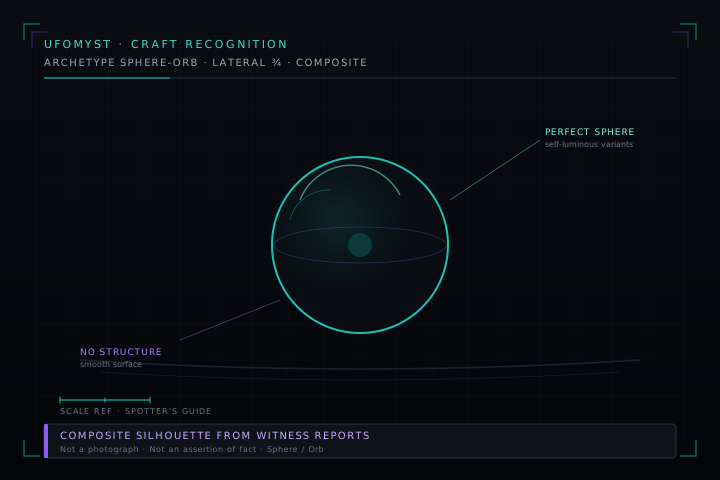
Sphere / Orb
A perfectly round object, ranging from a small glowing ball a few meters across to an enormous luminous globe hundreds of meters in diameter, most often reported hovering, pulsing in brightness, or moving with sharp, non-ballistic turns unlike any thrown or falling object. The sphere is ufology's most shape-shifting category in a literal sense: it spans everything from the ambiguous 'orb' captured accidentally in a photograph (frequently just dust or an insect caught by a camera flash close to the lens) to landed, physically substantial spheres investigators could walk up to, as at Voronezh, where witnesses described a giant sphere disgorging a three-eyed giant and a small robot, or the 2025 Buga sphere, an apparently solid metallic orb recovered from a Colombian riverbed. Between those extremes sit the classic luminous-sphere mass sightings — an entire town watching a silent, glowing globe hang in the sky for twenty minutes — where the object's size and solidity are inferred entirely from witness estimate rather than any recovered material.
Tic Tac
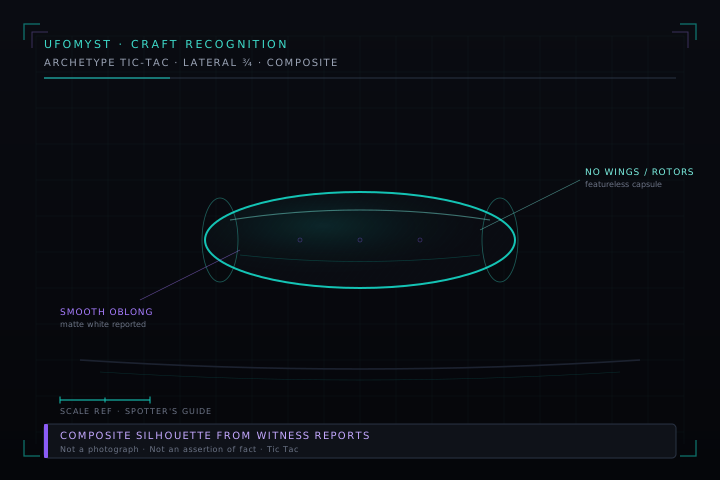
A smooth, white, featureless oblong roughly the size and proportion of the breath-mint candy that gave it its nickname: 40 feet long, no wings, no visible engines, exhaust, or control surfaces of any kind. The type entered public consciousness through Navy F/A-18 pilots off the coast of San Diego in November 2004, who watched a Tic Tac-shaped object mirror a jet's abrupt descent and then accelerate away with no visible means of propulsion, later captured on gun-camera infrared video. Unlike the disc or triangle, Tic Tac reports emphasize instrumented, cross-corroborated data over eyewitness narrative: multiple aircraft radar locks, a cruiser's advanced radar system tracking unknowns at the same coordinates over preceding days, and pilot testimony given years later under their real names to Congress and the press — a dramatic departure from ufology's usual anonymous-witness pattern. Reported flight behavior centers on what UAP investigators call 'the five observables': sudden and instantaneous acceleration, hypersonic velocity without a sonic boom, apparent antigravity lift, cloaking or sudden disappearance, and trans-medium travel between air and water. No entities or windows are ever reported with Tic Tacs — the entire case for anomaly rests on flight physics captured by military sensors rather than any morphological detail beyond the smooth, blank oblong shape itself.
USO / Transmedium Craft
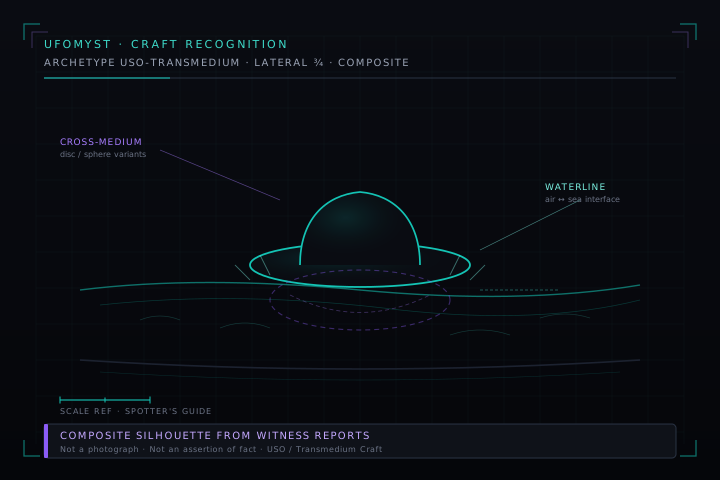
Not a fixed silhouette but a behavioral category: any craft — disc, sphere, cylinder, or otherwise — reported crossing between air and water (or, in a handful of accounts, air and solid ground) without slowing, breaking apart, or otherwise behaving the way a conventional vehicle must at that boundary. Unidentified Submerged Objects (USOs) proper are witnessed entering or emerging from open water at high speed with minimal splash; transmedium cases more broadly include craft that vanish and reappear across other physical boundaries. The category anchors two of the field's most physically dramatic incidents: Shag Harbour, Nova Scotia, where a lighted object was watched by multiple independent witnesses descending into the Atlantic — treated seriously enough that Canadian naval and coast-guard divers searched the bay for wreckage in the following days — and the 2013 Aguadilla, Puerto Rico infrared video, in which a federal surveillance aircraft's own camera recorded an object diving directly into the ocean and appearing to split into two before doing so.