Cigar / Mothership
- First reported
- November 17, 1986 (Japan Air Lines Flight 1628, though earlier 'airship' and cigar-shaped daylight-disc reports exist scattered through the 1950s-60s)
- Peak decade
- 1980s
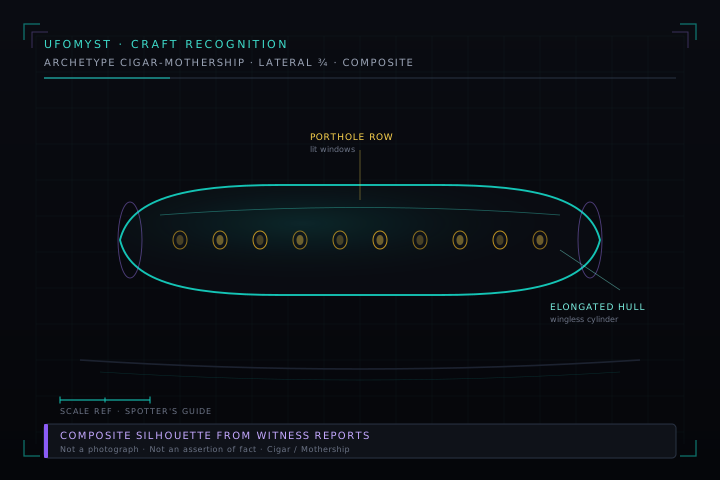
Composite silhouette from witness reports
Profile
An elongated, wingless, cylindrical craft — often windowless or lined with rows of small lit portholes — reported at a scale dramatically larger than any other type, sometimes described as 'the size of an aircraft carrier' or larger, sitting motionless in the sky for extended periods before smaller objects are seen departing from or returning to it. The mothership framing treats the cigar shape less as a single vehicle and more as a mobile base: several of the best-documented reports describe secondary discs or lights launching from, orbiting, and re-docking with the main body, a behavior pattern that has no equivalent among conventional aircraft carriers or airships. Unlike the flatter, lens-shaped disc, the cigar is reported as fully three-dimensional and torpedo-like, its great length emphasized far more than its width, and — unlike the black triangle — it is rarely described as flying low or fast; motherships are almost always reported hovering high and nearly still, more like a stationary object being examined from below than a craft in transit.
Skeptical reading
The JAL 1628 case's own FAA radar data is disputed: the ground controller's return was intermittent and consistent with a split radar target or ordinary traffic rather than a single coherent 40,000-foot-long object, and captain Terauchi's own drawings evolved somewhat between his initial report and later retellings. More broadly, cigar/mothership reports are especially vulnerable to misidentification of distant airships, blimps, or — since the 2010s — Starlink satellite launch trains, whose linear chain of lights at high altitude can read at a glance as one elongated solid object trailing smaller craft.