Flying Disc / Saucer
- First reported
- 1947 (Kenneth Arnold's 'saucers skipping on water' description, June 24, 1947 — the phrase predates the shape it now names)
- Peak decade
- 1950s-1960s
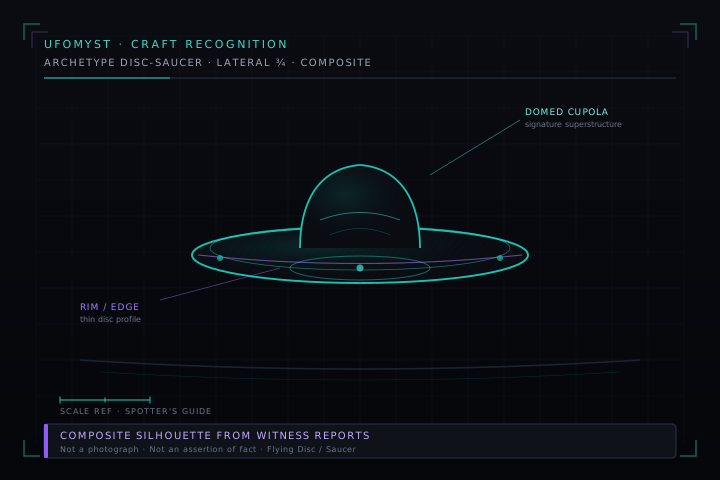
Composite silhouette from witness reports
Profile
The founding silhouette of the entire phenomenon, even though the man who coined 'flying saucer' was describing something closer to a skipping crescent. A disc or saucer craft is reported as a smooth, symmetrical lens — either a thin plate (the classic 'two plates rim to rim' profile) or a domed variant with a raised cockpit-like bubble on top, sometimes ringed by portholes or a pulsing band of light around its equator. The Adamski-type subvariant, specific to 1950s contactee photographs, adds three ball-shaped landing gear legs beneath a domed saucer and a distinctive scalloped rim — a design later proven to match a hardware-store chicken-feeder incubator lamp with ping-pong balls attached. In flight, witnesses describe silent hovering, sudden vertical ascents, and a wobbling 'falling leaf' descent pattern distinct from any known aircraft. Domed saucers are disproportionately the type reported as landing, sometimes with occupants (usually Suited Dwarfs or Nordics) emerging or visible through the dome. The shape dominates the earliest years of the phenomenon (1947-1965) before daylight discs gradually gave way to the boomerangs, triangles, and unlit orbs of later decades — Hynek's own six-category system still keeps 'Daylight Disc' as one of its three basic sighting classes precisely because of how much of the early record this shape carries. The saucer remains pop culture's default UFO silhouette long after field reports diversified away from it, which is itself a data point about how much the image feeds back into what later witnesses expect to see and describe.
Skeptical reading
The disc is ufology's most thoroughly 'explained' shape: lenticular clouds, Venus and other bright planets seen through atmospheric distortion, weather balloons, and — for the Adamski photographs specifically — a small hoaxed model, all account for a large share of reports. Its cultural dominance in film and toy design (itself downstream of Arnold's original misquoted description) is widely cited as the reason 'disc' remained the public's default mental image even after field reports shifted toward lights, triangles, and orbs from the 1970s onward.