The Kenneth Arnold Sighting
On June 24, 1947, private pilot Kenneth Arnold watched nine gleaming objects skim past Mount Rainier at a speed he calculated at over 1,600 mph — three times faster than any aircraft of the day. A reporter's paraphrase of his words gave the world a new term: 'flying saucer.' The modern UFO era begins here.
- When
- June 24, 1947
- Where
- Mount Rainier, WA, USA
- Witnesses
- 1
- Physical evidence
- No
- Military involvement
- No
The Sighting
Kenneth Arnold was a 32-year-old businessman, search-and-rescue pilot, and deputy federal marshal from Boise, Idaho — by every account a practical, respected man. On the afternoon of June 24, 1947, he was flying his CallAir A-2 from Chehalis to Yakima, Washington, taking a detour near Mount Rainier to look for a crashed Marine Corps C-46 transport that carried a $5,000 reward.
At about 3:00 p.m., a bright flash caught his eye. To the north, he saw a chain of nine objects flying south along the Cascade ridgeline, weaving between the peaks 'like the tail of a kite.' They flipped and banked, flashing in the sun like mirrors. Arnold described eight of them as flat, thin, and rounded in front with convex or slightly pointed rears; one appeared crescent-shaped. Using the dashboard clock, he timed their passage between Mount Rainier and Mount Adams — 47 miles in one minute and 42 seconds. The arithmetic gave roughly 1,660 mph. No aircraft on Earth in 1947 could officially fly faster than about 620 mph.
The Investigation
Arnold landed in Yakima, mentioned the sighting, and by the time he reached Pendleton, Oregon, reporters were waiting. Crucially, Arnold told Bill Bequette of the East Oregonian that the objects moved 'like a saucer would if you skipped it across the water' — a description of motion, not shape. The wire story compressed this into 'flying saucers,' and within weeks hundreds of Americans were reporting saucer-shaped craft. Skeptics have long noted the irony: people began seeing the shape the newspapers invented, not the shape Arnold described.
The sighting triggered the first official U.S. government interest in UFOs. Army Air Forces intelligence interviewed Arnold, and his case became foundational to Project Sign (1948) and later Project Blue Book. Military analysts privately rated Arnold credible but the observation unresolvable.
In July 1947 Arnold was drawn into the bizarre Maury Island affair, a case that would darken his view of the entire subject within weeks of starting it. Harbor patrolman Harold Dahl and his associate Fred Crisman claimed to have witnessed doughnut-shaped objects raining hot metallic debris onto a boat in Puget Sound, injuring a crew member and killing a dog. Arnold, drawn in as an independent investigator, brought in two Army Air Forces intelligence officers, Captain William Davidson and Lieutenant Frank Brown, to examine the debris. Flying the samples back to California that August, their B-25 crashed, killing both men — a tragedy immediately entangled with saucer rumor, though an Army investigation attributed it to mechanical failure and overloading, not sabotage. Dahl and Crisman's account itself later unraveled as a fabrication; Crisman admitted mailing rock slag to a magazine editor to sustain the hoax. The episode cost Arnold real credibility by association even though he had been a target of the deception rather than its author, and it visibly soured him on the movement his own sighting had launched.
Arnold's Mount Rainier report also triggered, within days, one of the most underappreciated statistics of the entire UFO era: American newspapers logged more than 800 separate saucer sightings across the country in the two weeks following his account, an outbreak so immediate and so geographically dispersed that it remains a foundational case study for researchers of media contagion in anomaly reporting, independent of whatever Arnold himself actually saw over the Cascades.
The Witnesses
Arnold's sighting was not, in fact, solitary for long. On July 4, 1947 — ten days later — a United Airlines DC-3 crew captained by Emil Smith spotted five, then four more, disc-shaped objects pacing their aircraft over Idaho for several minutes in front of passengers; investigators at the time considered the Smith crew sighting, made by trained professional aviators with no financial or reputational incentive to embellish, evidentially stronger than Arnold's own.
Arnold himself never fully escaped what he started. In 1952 he self-published, with Ray Palmer — the pulp-magazine editor who had helped popularize flying-saucer lore through Amazing Stories and Fate — a book titled 'The Coming of the Saucers,' his own detailed account of the sighting and its chaotic aftermath, written partly to correct what he felt were years of media distortion of his original testimony. Broadcaster Edward R. Murrow interviewed him in 1950, and Arnold claimed three further sightings of nine-object formations in the years since. He bought motion-picture equipment hoping to film corroborating evidence and never did. He ran, unsuccessfully, for Idaho lieutenant governor in 1962, worked for years afterward largely outside the UFO research establishment he had inadvertently founded, and in a rare public appearance at the 1977 First International UFO Congress, he reflected — with evident weariness — that he had simply reported what any pilot would have reported, and had spent three decades paying for it in ridicule and distortion. He died in 1984, having never once changed a material detail of his account.
The Explanations
Official and skeptical explanations have ranged widely. The Air Force initially suggested a mirage: temperature inversions over the Cascades can make distant mountaintops shimmer and appear to detach. Astronomer Donald Menzel proposed, at various times, mirage effects, snow blowing off ridges, or water droplets on the windscreen. Later analysts suggested a flight of military jets, a fireball meteor breaking apart (though the objects' 102-second transit is far too long), or American white pelicans flying in echelon — the much-mocked 'pelican hypothesis.' Each explanation accounts for part of the report; none comfortably accounts for all of it, particularly Arnold's estimate of size (he judged them 45-50 feet wide) combined with the timed distance.
Defenders of the sighting point out that Arnold was an experienced mountain pilot familiar with mirages and aircraft, that he volunteered his report reluctantly, and that he never monetized or embellished it. If his distance estimate was wrong, the objects could have been closer and slower; but then their apparent size and disappearance behind terrain become hard to explain. Army Air Forces investigators who interviewed him at the time reached a similar conclusion in their own confidential assessment, writing that it was 'difficult to believe that a man of [his] character and apparent integrity' would report something he had not genuinely seen — a private judgment of credibility, buried in period intelligence files, that later became one of the case's most-quoted lines once declassified.
Modern Developments
Arnold's report now anchors the official historical record on UAP: the Pentagon's All-domain Anomaly Resolution Office and the 2021 preliminary assessment from the Office of the Director of National Intelligence both date the 'modern era' of UFO reporting to 1947, with Arnold's sighting treated as the inaugural data point even in strictly bureaucratic accountings. The 2020 documentary 'The Phenomenon,' directed by James Fox and featuring former Senate Majority Leader Harry Reid and ex-Pentagon official Christopher Mellon, opens its historical survey with archival interview footage of Arnold explaining, in his own words, how a wire reporter's phrase outran his actual testimony — a sequence now widely used to illustrate how UFO terminology itself was born from a media distortion rather than a witness claim. Ufologists and skeptics alike now regularly invoke Arnold's case not to argue what he saw, but to demonstrate how fast an ambiguous sighting can calcify into cultural mythology once the press names it.
A detail modern researchers increasingly emphasize when they revisit the original 1947 wire copy: Arnold's own careful language, buried under decades of borrowed vocabulary, described objects with an erratic, weaving flight path far closer to what today's Navy pilots call unpredictable non-ballistic movement than to any classic 'flying saucer' silhouette — a reminder, proponents argue, that the phenomenon's most persistent reported signature was never the shape in the name, but the motion underneath it.
Why It Endures
Every UFO wave, every saucer photograph, every government study descends from those 102 seconds over the Cascades. Arnold's sighting established the archetype: a credible, technically competent witness; an observation with numbers attached; a press machine that transformed it; and an official explanation that satisfied almost no one. Two weeks later, the Roswell press release would borrow his vocabulary. The 1952 Washington, D.C. flap, the contactee movement, Blue Book itself — all unfolded inside the conceptual container built on June 24, 1947. Perhaps most tellingly, the phenomenon Arnold described — high-speed, high-G objects with no visible means of propulsion, seen by a trained pilot — is virtually identical to what U.S. Navy aviators would report off San Diego in 2004. The modern era's first report and its most famous recent one describe the same impossible performance, 57 years apart. Arnold himself remained, to the end, a reluctant and dignified figure in a story he never asked to own — the accidental founder of a vocabulary that outlived, and outgrew, everything he actually said.
Official investigation
Project Sign/Blue Book file; officially attributed to mirage or misperception
Evidence & media
4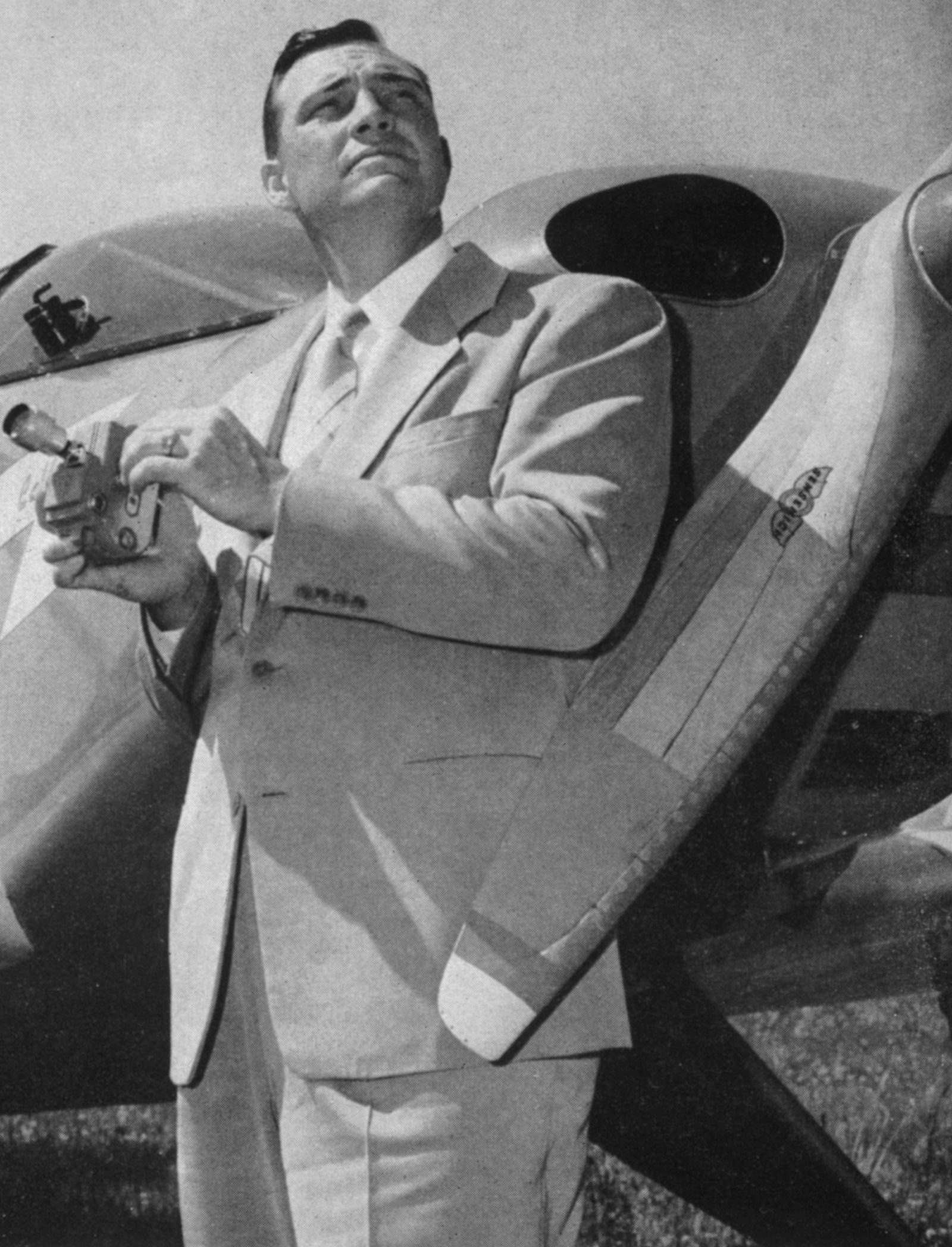
Kenneth Arnold beside his private aircraft shortly after his June 24, 1947 sighting over Mount Rainier that gave the world the term 'flying saucer.'Source ↗ 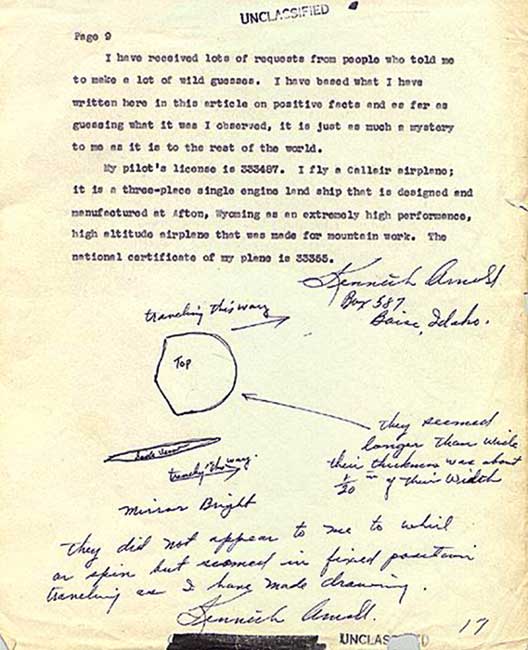
Kenneth Arnold's own written account/report of his sighting, submitted in the days after the event, July 1947.Source ↗ 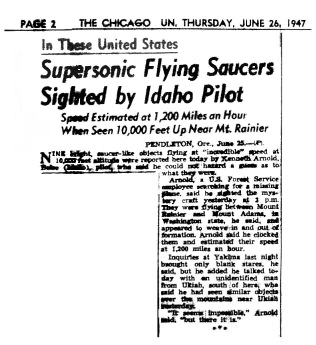
Chicago Sun wire-service front-page clipping on the 'flying saucer' story, June 26, 1947.Source ↗ 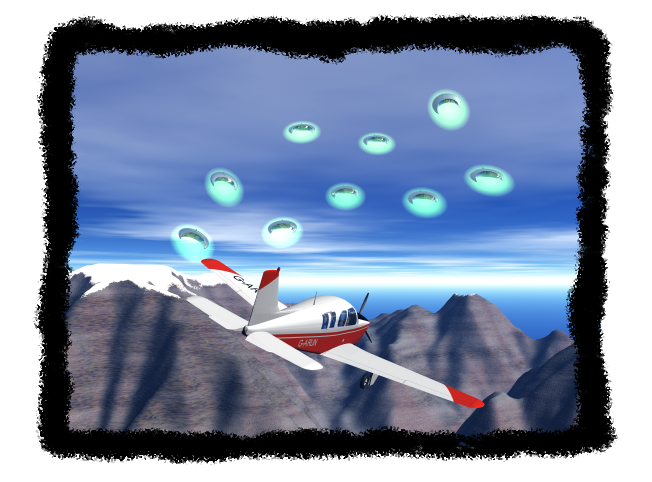
Diagram reconstructing the formation and flight path Arnold described for the nine crescent-shaped objects near Mount Rainier.Source ↗