Cylinder
- First reported
- Scattered throughout the record from the 1950s onward, without a single defining case
- Peak decade
- Steady across the modern record rather than concentrated in one wave
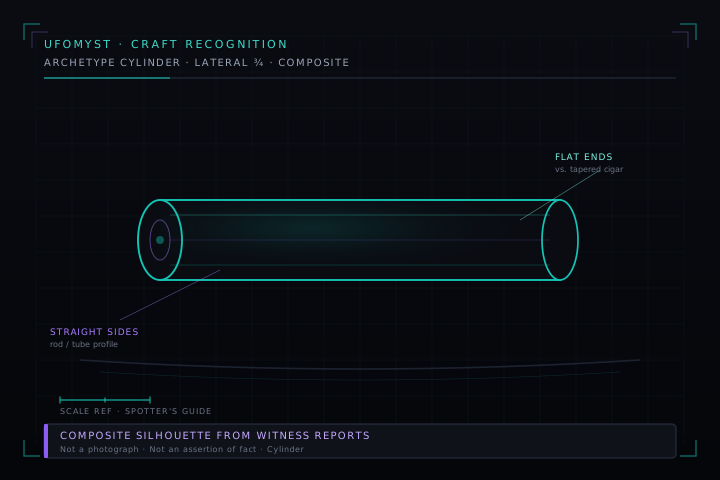
Composite silhouette from witness reports
Profile
A straight-sided, rod- or tube-shaped object with flat or slightly rounded ends, distinguished from the tapered cigar by its uniform diameter along its full length — closer to a length of pipe than a torpedo. Cylinders are reported across a very wide range of contexts, from brief daylight overflights to extended hovering encounters, and the category's raw NUFORC report count (over 2,100 U.S. sightings) is large despite the type having no single dominant famous case anchoring it the way the disc has Arnold or the egg has Socorro — making it one of the more diffuse, evenly-distributed shapes in the record rather than one built around a handful of landmark encounters. Witnesses describe cylinders in two distinct registers: a fast, purposeful daylight overflight lasting only seconds, often compared afterward to a passing airliner fuselage stripped of wings and tail; and a slower, silent, close-range hover lasting minutes, sometimes with a dull metallic sheen or a row of small lights or windows along one side. Unlike the tapered cigar, which reads to witnesses as a single purposeful vessel, the plain cylinder is more often described in flatly mechanical terms — a pipe, a torpedo, a fuel tank — language that itself hints at how readily this particular silhouette gets compared to ordinary hardware rather than to anything overtly exotic.
Skeptical reading
Rocket-body reentries and spent booster stages tumbling through the upper atmosphere are the most common confirmed source of cylinder reports — their straight, elongated silhouette and slow tumble closely match witness descriptions, and satellite-tracking databases have retroactively matched a meaningful share of well-timed cylinder sightings to known reentry events. Contrails and aircraft seen end-on, where the fuselage foreshortens into an apparent tube shape, account for a further share of daylight reports. Because the cylinder lacks a single anchoring famous case the way the disc has Arnold or the diamond has Cash-Landrum, it also lacks a corresponding concentrated skeptical literature — investigators tend to fold individual cylinder reports into whichever broader wave or flap they occurred during (1947, 1954, 1973, 1989) rather than studying the shape as its own phenomenon, which paradoxically leaves it under-scrutinized relative to its raw report volume.