The Varginha Incident
Three young women crossing a vacant lot in a Brazilian coffee town met a crouching creature with oily brown skin, three head protrusions, and huge red eyes. Within days, rumors swirled of military trucks, captured beings, and a young policeman dead of sudden infection after allegedly handling one. 'Brazil's Roswell' triggered an official inquiry, a congressional hearing — and thirty years of unbroken testimony.
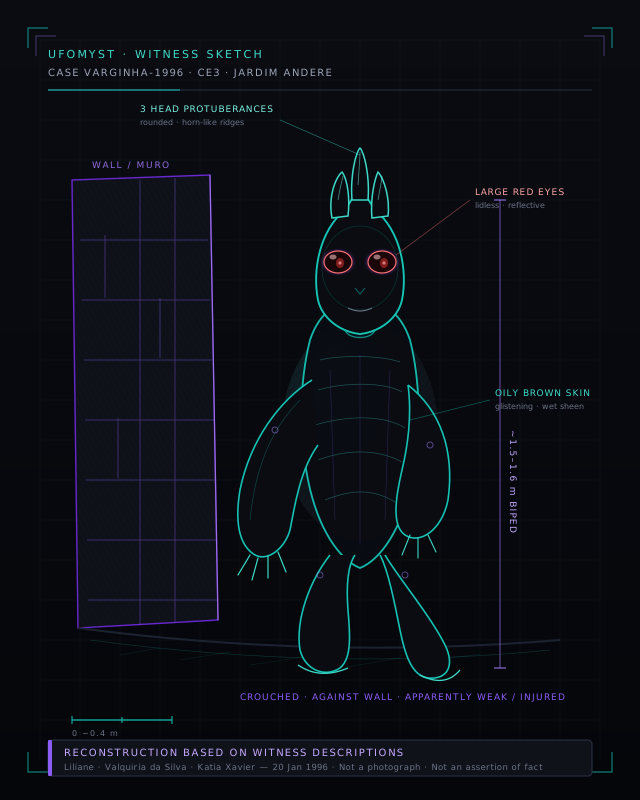
Reconstruction based on witness descriptions
- When
- January 20, 1996
- Where
- Varginha, MG, Brazil
- Witnesses
- 10
- Physical evidence
- No
- Military involvement
- Yes
The Sighting
On the rainy Saturday afternoon of January 20, 1996, sisters Liliane (16) and Valquiria (14) da Silva and their friend Katia Xavier (22) were cutting through the Jardim Andere district of Varginha, a prosperous coffee-trade city in Minas Gerais, when they saw something crouched against a wall in a vacant lot: a creature they described as humanoid, about 1.5 meters, with glistening oily brown skin, a large head bearing three rounded protuberances like horns or ridges, enormous red eyes, and thin limbs — apparently weak, wobbly, or injured, seemingly stunned by their presence. The girls fled in terror, telling their families immediately; their mothers found them shaking and crying, and neighbors recalled the commotion the same day.
Around this nucleus, a far larger narrative rapidly assembled, chiefly through the work of local researchers Ubirajara Franco Rodrigues and Vitorio Pacaccini, who spent the following weeks and years collecting testimony from firefighters, soldiers, hospital staff, and bystanders. Their reporting knit the girls' ninety seconds into a sprawling account of a downed craft, a military capture operation, and a cover-up reaching the Army's local command. Direct, named, first-hand testimony remains strongest for the three girls' encounter itself; nearly everything that follows rests on testimony gathered second-hand, much of it decades later.
The Military Operation
Researchers allege that in the pre-dawn hours of January 20, 1996, a NORAD-flagged unidentified object was tracked over the region, and that days earlier a strange submarine-shaped craft had been seen struggling low over nearby farmland. On the day of the girls' sighting, fire department and army personnel are said to have captured one or two creatures nearby, transporting them under tarpaulins to a secure location; a second creature was reportedly taken to Varginha's Regional Hospital and later transferred amid unusual military movement. Among the soldiers researchers say took part in this unofficial operation was 23-year-old military policeman Marco Eli Chereze, who allegedly restrained a creature bare-handed — and who died weeks later of a fulminant infection (see "The Death of Marco Eli Chereze," below). The Army's Eastern Military Command has consistently denied any capture operation occurred, describing that week's vehicle movements as routine transport tied to an unrelated exercise.
The Hospital Accounts
Ufologists' central claim is that a creature, or creatures, passed briefly through Varginha's Regional Hospital before being removed by military personnel — built largely from hospital workers' secondhand recollections of a cordoned-off area, unfamiliar guards, and hushed staff instructions in the days after January 20, 1996.
The most detailed hospital account did not surface until three decades later. In footage recorded for a continuation of filmmaker James Fox's documentary "Moment of Contact" and in a subsequent interview with CNN Brasil, Varginha neurologist Dr. Italo Denelle Venturelli said that in 1996, while visiting a young surgical patient at the hospital, a colleague called him aside into an improvised, screened-off isolated area. There, he says, he saw a small being for two or three minutes: pale skin, lilac-colored eyes, and a teardrop-shaped head, calm and roughly the apparent size of a seven-year-old child. Venturelli says he told almost no one for nearly thirty years, fearing professional ridicule, and that he possesses no photograph, video, or medical record of the encounter. His account cannot be independently corroborated; after it aired, people reportedly offered him money for a videotape he says does not exist, and foreign news crews sought him out. It remains, by its nature, a single physician's uncorroborated late-life testimony, presented here as exactly that — a striking recent addition to the case file, not a verified fact of it.
The Zoo Incident
Among the case's stranger and less-told threads is a report from the Varginha municipal zoo. According to researchers, a woman named Terezinha Galo Clepf told her family that in the weeks after the January sighting she encountered a similar red-eyed creature at the zoo; she has since died, and her account is now relayed by her son, who has described her as visibly shaken whenever she recalled it — "she trembled a lot," he has said. Brazilian ufologist sources report that in the days following her sighting, several zoo animals died in circumstances locally considered unusual, with some accounts naming a tapir, deer, and an ocelot among the dead. No necropsy findings, veterinary records, or official investigation into the animal deaths have been published or independently verified; the claim rests entirely on local recollection and ufologist reporting, and is presented here without confirmation of any medical or forensic finding.
The Death of Marco Eli Chereze
On February 15, 1996 — twenty-six days after the Jardim Andere sighting — 23-year-old Marco Eli Chereze, a corporal in the Minas Gerais Military Police, died in the intensive-care unit of Varginha's Regional Hospital do Sul de Minas. Ufologists, including researchers Vitorio Pacaccini and Edison Boaventura Jr., allege Chereze took part in an unofficial nighttime operation in Jardim Andere on January 20 and, working without gloves, restrained a creature that scratched or otherwise broke his skin — the wound they say seeded the infection that killed him.
The documented medical record shows a genuinely swift and severe illness: an abscess developed under his arm in the days after January 20, and the pathologist who examined him, Joao Baptista 'Macuco' Janini, found overwhelming septicemia — a generalized bacterial infection — and later wrote that in decades of practice he had 'never seen anything like it.' A 1997 Military Police inquiry (IPM no. 18/97) concluded the death had purely natural medical causes and found no evidence that any capture operation, or contact with an unidentified organism, had occurred that night.
No verified lawsuit against the Union or the Army by the Chereze family appears in available public records. His sister, Marta Antonia Tavares, has spoken about the case in interviews decades later, and reporting describes the funeral as unusually rushed — a sealed casket, no public viewing — a detail ufologists cite as suspicious and that the Army has never directly addressed. The researchers most associated with the case stop short of asserting proof: Boaventura frames the question as one of context rather than certainty, and Pacaccini calls for transparency rather than alleging a cover-up outright. What is not in dispute is that a healthy, athletic 23-year-old died of an infection aggressive enough to startle the doctor who diagnosed it, leaving Chereze's death the case's most solemn, and least resolved, thread.
The Explanations
The skeptical reconstruction, developed by Brazilian skeptics and echoed internationally: a startled encounter with a crouching, rain-soaked disabled man (or, per some, even an animal) was reshaped within hours by family retelling in a country with vivid UFO culture; two energetic local ufologists then aggregated every odd occurrence of that summer — routine troop movements, an unrelated death, hospital gossip, a grieving zoo employee's memory — into a retrieval epic, with anonymous military 'sources' supplying the connective tissue. The case's growth pattern (a modest core inflating through secondhand claims) matches classic legend formation, and the total absence of physical evidence after thirty years is telling.
The pro-anomaly case: the girls' immediate, emotional, and permanently consistent testimony describes something no rain-soaked man resembles — three head protuberances and red lidless eyes at two meters' distance in daylight; Chereze's death from overwhelming infection at 23 remains medically unexplained to his family, who were denied records; multiple named firefighters and soldiers have been identified by researchers (some later giving partial confirmations); and the military's shifting, incomplete explanations — plus its documented practice of secrecy revealed in the Colares files — make its denials weightless in Brazil. In 2022, decorated Brazilian Air Force officers publicly called for the case's files to be opened, implying files exist.
A minority of researchers reject the extraterrestrial framing entirely. Investigator Rony Vernet has argued the case involved no spacecraft at all, but a 'dimensional' or occult event: portals allegedly opened by wealthy farmers practicing black magic, said to have summoned entities through Umbanda and 'Sao Cipriano' ritual practices. In this account, witnesses also described a separate hairy, Bigfoot-like being — a 'ser peludo' — emerging from the ground in the same area. This occult-origin theory sits outside both the mainstream ufological and skeptical readings of Varginha and has not been adopted by the case's principal researchers; it is noted here as a minority claim circulating in Brazilian paranormal circles, not as an established element of the case.
The 2022 Revival
Varginha's third act began with American filmmaker James Fox's 2022 documentary "Moment of Contact," which returned to the case for English-speaking audiences three decades on, gathering new interviews with aging witnesses and, according to participants, on-camera statements from military figures willing to speak for the first time. The film's release — and a follow-up round of filming that produced Dr. Venturelli's hospital account — triggered a fresh wave of Brazilian press coverage and renewed calls, including from decorated retired Air Force officers at 2022 congressional-style hearings, for the Army's original files to be declassified in full. James Fox, previously known for the UAP documentary "The Phenomenon" (2020), does not yet have a dedicated entry in this site's library of ufologists and researchers.
Why It Endures
Varginha is the world's leading modern entity case and the southern hemisphere's Roswell — but with living witnesses who were teenagers, not aging memories of 1947. It distills the entire crash-retrieval mythos into one testable town: either Brazilian institutions concealed the century's greatest event, or a frightened glimpse plus two determined investigators built a global legend in a fortnight — and both possibilities illuminate how UFO history is made. The case cemented Brazil's status as ufology's most active nation, drove its congressional hearings of the 2020s, and turned Varginha itself into a pilgrimage economy. Three decades on, new claimants — a neurologist, a dead zoo worker's grieving son — still keep the file open. Three women in their forties and fifties still tell the same ninety seconds the same way. Everything else remains, precisely, contested.
Official investigation
Brazilian Army inquiry (1996) and Military Police report: creature was a homeless man nicknamed 'Mudinho'; ufologists reject the finding
Evidence & media
2
Tags
Sources
- Varginha UFO incident — Wikipedia
- The Varginha UFO Incident Of 1996 — All That's Interesting
- Brazil's Roswell Moment: The Varginha Incident Revisited — Discovery UK
- Moment of Contact (2022) — IMDb
- Médico afirma que viu ET de Varginha em hospital — Correio Braziliense
- Caso ET de Varginha: 'ela tremia muito', diz filho ao relembrar relato da mãe sobre criatura no zoológico — G1
- 'Eu nunca vi coisa igual na vida', diz legista de caso relacionado a ET de Varginha — Portal Vigília
- Militar morreu após suposto contato com o ET de Varginha e logo surgiram várias teorias — Correio Braziliense
- ET de Varginha não era alienígena? — Space Paranoia (minority occult-origin theory, Rony Vernet)