The Socorro Landing (Lonnie Zamora Incident)
Chasing a speeder outside Socorro, New Mexico, police officer Lonnie Zamora heard a roar, saw flame in the sky, and found an egg-shaped craft on legs in a gully — with two small figures beside it. It blasted off before his eyes, leaving burning brush and landing imprints. Project Blue Book investigated hard and gave up: the case remains officially unidentified.
- When
- April 24, 1964
- Where
- Socorro, NM, USA
- Witnesses
- 1
- Physical evidence
- Yes
- Military involvement
- Yes
The Sighting
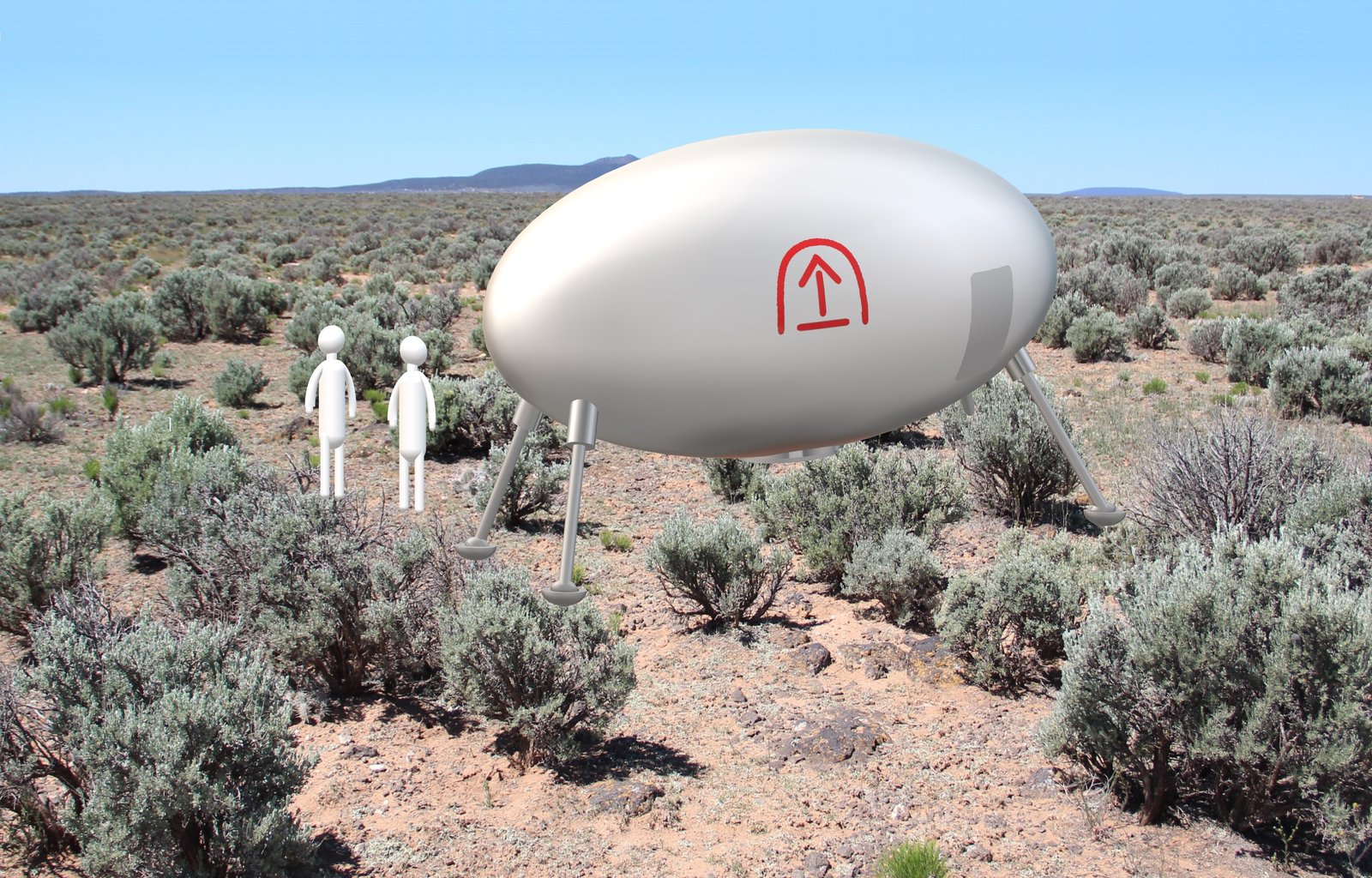
Around 5:45 p.m. on April 24, 1964, Sergeant Lonnie Zamora of the Socorro police was pursuing a speeding car south of town when he heard a roar and saw a cone of blue-orange flame descending beyond a rise — near a dynamite shack, he thought. Abandoning the chase, he drove his cruiser up the rough mesa road. Cresting the ridge, he saw a shiny, whitish object sitting in a gully about 150-200 yards away. He took it for an overturned car. Beside it stood two small figures in white coverall-like garments — 'normal in shape but possibly small adults or large kids,' he later said. One appeared to startle at seeing his car.
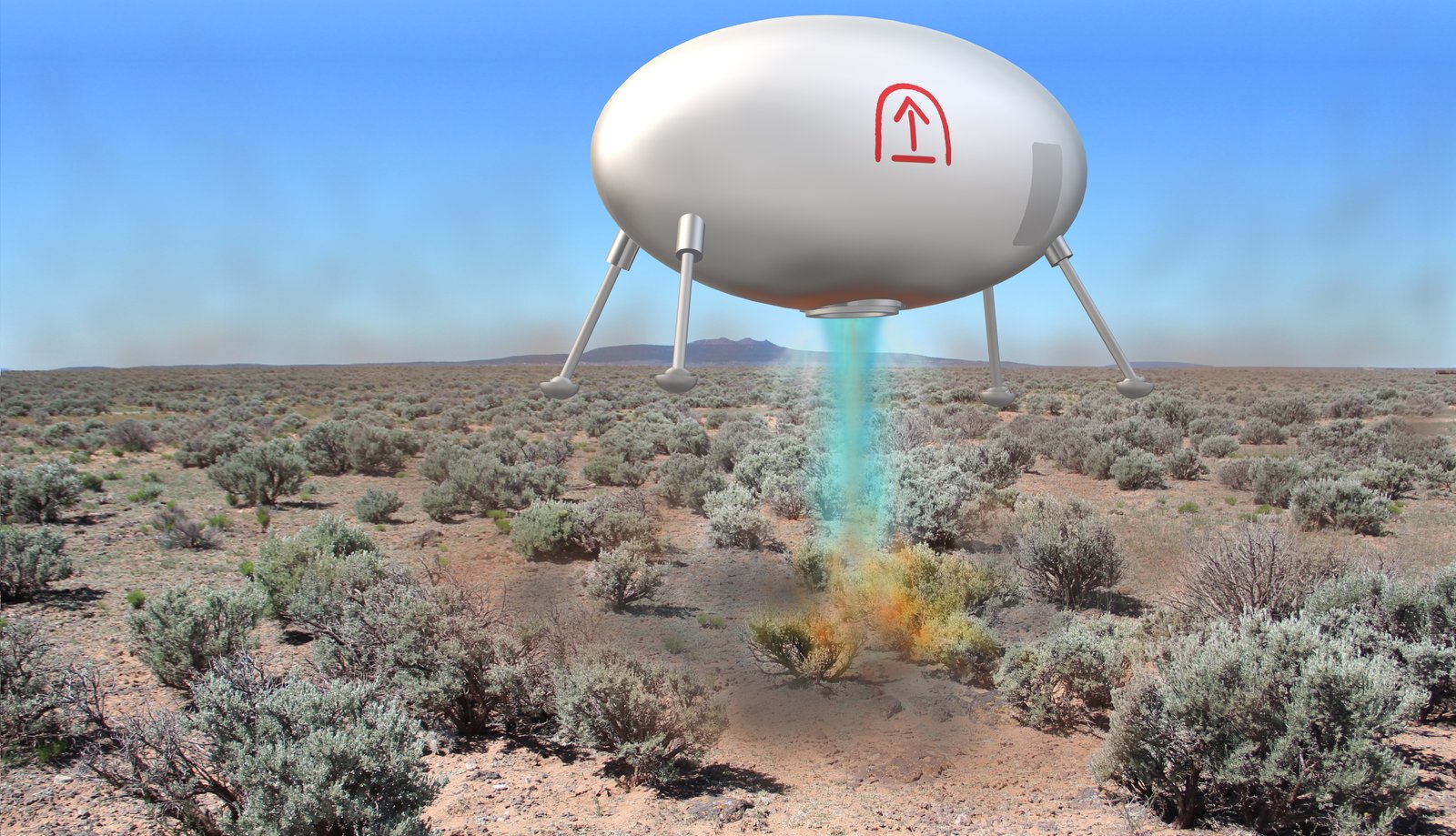
Zamora radioed dispatch and drove closer. As he stepped from the cruiser he heard loud thumps, like a door closing. The object — smooth, aluminum-white, egg-shaped, on angled legs, bearing a red insignia roughly like an arrow inside an arc — erupted with a roar and flame from beneath. Zamora fled, banging his leg and dropping his glasses, and crouched behind the ridge as the object rose, went silent, and sped away over the mountains. Within minutes Sergeant Sam Chavez of the state police arrived to find Zamora pale and sweating — and the greasewood brush in the gully still burning. Four wedge-shaped landing imprints, each pressed into the hard ground, marked the corners of a quadrilateral.
The Investigation
The response was immediate and heavyweight. The FBI (an agent happened to be in the Socorro office), Army intelligence from White Sands, and Project Blue Book all investigated within days. Blue Book sent its scientific consultant, astronomer J. Allen Hynek, twice. Soil was sampled and analyzed at Air Force labs: no propellant residue, no radiation above background, no foreign substances. Engineers estimated the imprints implied a load of at least a ton at each pad. The insignia was documented; investigators asked Zamora to keep one detail confidential to screen copycats, a standard technique for filtering out later false confessions and copycat reports, and it worked: no subsequent hoax claimant ever independently reproduced the withheld detail. Background checks described Zamora as sober, industrious, and not given to fantasy. Blue Book chief Major Hector Quintanilla, no friend of saucer stories, wrote that Zamora's reliability was not in question, chased every rocket, lunar-lander, and classified-program lead he could find at White Sands Missile Range — the most likely source of any genuinely secret hardware in the area — and came up empty. The case was stamped UNIDENTIFIED, one of the most consequential unknowns in Blue Book's 12,618 files. Hynek called Zamora one of the most unimpeachable witnesses he had ever met and mused that Socorro might be the 'Rosetta stone' of the phenomenon.
The Witnesses
Zamora himself is the case's most instructive witness precisely because of how little he wanted the attention. He gave measured, consistent statements to every investigator who asked, never sold his story, and by most accounts came to actively resent what the sighting did to his life — the tourists, the ridicule from colleagues who hadn't been there, the endless requests to retell the worst ten minutes of his career. He eventually left the Socorro police force and worked at a propane company until retirement, granting few interviews and changing nothing material in his account for the rest of his life. He died on November 2, 2009, in Socorro, at age 76, having outlived nearly every skeptical theory advanced against him. In 2012, three years after his death, city officials commissioned a mural depicting the encounter on a Socorro spillway — a belated civic embrace of the event that had once made Zamora a target of mockery among some in his own town.
The Explanations
Every prosaic candidate has been tried. A lunar-lander test from White Sands? Records show no Surveyor or LEM test flights that day, and none matched the description. A hoax by New Mexico Tech students to embarrass a disliked traffic cop? This theory gained life from a 1968 letter in Linus Pauling's correspondence and a 2009 claim by a Tech alumnus citing a deceased university president's wink — but no student ever came forward, no mechanism for the flame, roar, imprints, and flight was demonstrated, and Zamora's terror was witnessed minutes later by a fellow officer. A hot-air balloon stunt, a mirage of the planet Venus (astronomer Donald Menzel's early suggestion, later abandoned even by him), or a small experimental craft — each fails on some combination of the physical traces, the daylight close range, and the performance.
Skeptics reasonably note the case rests on one witness for the object itself, that the 'beings' were seen briefly at distance without detail, and that landing-gear imprints and burned brush can be manufactured. Proponents answer that the totality — a police officer of tested credibility, physical traces documented within an hour by independent officers, and an Air Force investigation that wanted an answer and could not produce one — makes Socorro the strongest close-encounter landing case in the American record.
Independent researcher Ray Stanford, who arrived in Socorro within days and spent years reinvestigating the case for his book 'Socorro Saucer,' claimed to have located additional corroborating witnesses missed by Blue Book, including motorists on the highway who reported a low-flying, flame-emitting object minutes before or after Zamora's encounter. These secondary witnesses were never as rigorously vetted as Zamora himself and their accounts carry correspondingly less weight in the mainstream literature, but Stanford's fieldwork is still cited by researchers arguing the official file, thorough as it was, did not capture every person who saw something that afternoon.
The red insignia remains the case's single most argued-over physical detail: Zamora sketched it from memory immediately after the encounter, described it consistently in every subsequent interview, and investigators withheld its exact configuration from public release specifically to filter false confessions — yet no consensus on its meaning ever emerged. Proposals have ranged from a corporate or military test-program logo to, more speculatively, an attempt at a genuinely unfamiliar symbol system; none has been matched to any known American or foreign insignia of the period, leaving it the case's most concrete and least explained artifact — a single hand-drawn shape that has outlasted every explanation offered for the object it was painted on, reproduced in books, documentaries, and museum displays for six decades without ever being resolved.
Modern Developments
Socorro is one of the small handful of classic cases to earn a place in James Fox's 2020 documentary 'The Phenomenon,' where researchers cite it, alongside Roswell, Westall, and Kenneth Arnold's sighting, as one of the touchstone incidents that shaped serious post-war ufology — largely because it is a case the U.S. government's own investigators, working in real time and hostile to the subject, could not close. The case continues to circulate in 2020s congressional and AARO-adjacent discussions of historically unresolved American UAP encounters specifically because of that official 'unidentified' stamp; researchers arguing for renewed federal investment in UAP analysis regularly cite Socorro as proof that credible, physically corroborated cases have gone unresolved for sixty years for lack of follow-up, not lack of substance.
Why It Endures
Socorro is the case skeptics' skeptics respect. It forced the U.S. government's own investigators to write 'unidentified' on a close-range, daylight, physical-trace, entity sighting — a category supposedly reserved for the credulous. It marked the turning point in Hynek's journey from Blue Book debunker to founder of scientific ufology, and his classification system (Close Encounters of the First, Second, Third Kind) is stamped with Socorro's DNA: Zamora's sighting is the paradigm CE3. The red insignia, the wedge imprints, and the image of a small-town cop standing alone before something that then left the Earth remain among ufology's most concrete and most haunting artifacts. Socorro, after decades of ambivalence, embraced the history it once mocked: the landing site arroyo is marked, and the city commemorates the encounter that made it famous. Unlike Roswell or Kecksburg, the town has never built its economy around the sighting, keeping Socorro's relationship to its own case unusually low-key for a location this significant in the literature — a small New Mexico university and mining town that happens, almost incidentally, to own one of ufology's hardest unsolved files. Among investigators, an informal test endures — 'explain Socorro' — because any general theory of UFO reports, skeptical or exotic, must pass through a gully where the ground itself testified.
Official investigation
Project Blue Book: officially UNIDENTIFIED — one of its most prominent unknowns